
What Is an AI Employee? A Definition — and a Working Example
September 15, 2026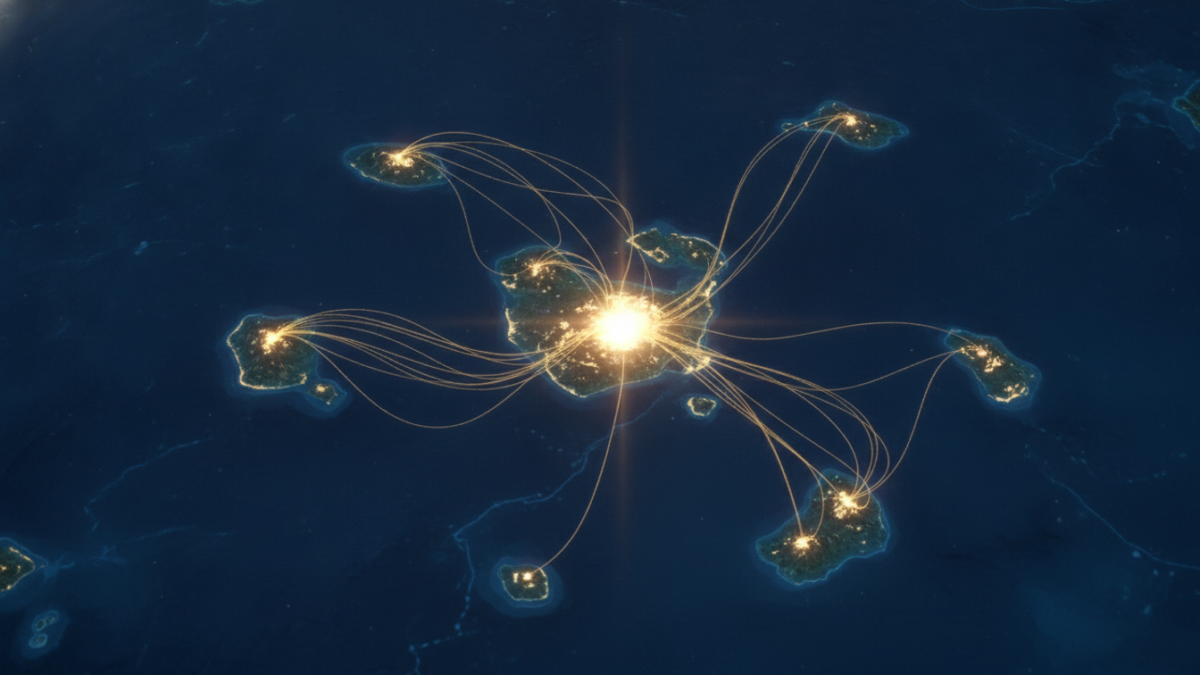
Durban, South Africa — 15 September 2026
For the first time, an entire company — its ledger, its money, its customers, its stock, its work and its communication — exists as one system with one employee running it. It has never been done. It is done.
Every business on earth runs on an archipelago.
This is not a metaphor about inconvenience. It is the actual architecture of the modern economy. The accounting lives in one system. The customers in another. Email in a third. Quotes, orders, stock, jobs, suppliers, projects, support — each on its own island, each built by a different company, each with its own idea of what a customer is and what money is. The largest enterprise suites in the world are not exceptions to this. They are archipelagos with a shared login — decades of acquisitions stitched together, sold as one thing, operated as twelve.
Between the islands there is only water, and across that water the world employs hundreds of millions of people whose real job — whatever their title — is to carry a fact from one system to another without dropping it.
The industry has known this for forty years, in every country. Its answer was bridges. Integration platforms, connectors, middleware, sync engines: an entire sub-industry worth tens of billions, built on the premise that the islands are permanent and the best we can do is ferry faster.
Wolfatek Evolutions has today announced the alternative that the industry decided was impossible. We did not bridge the islands. We built the country.
The magnitude of what was built
There is no partial version of this. You cannot unify a business by unifying most of it. If the stock system and the ledger disagree by one line, you have two systems and a reconciliation. So the only route was to build every module a business needs, from the ground, on one foundation, with one shared theory of identity, money, permission and memory — and to hold every one of them to that theory without exception.
That is what the last few months were. The scale of it:
A complete, rigorous financial core. Double-entry general ledger with immutable posted journals. Receivables and payables. Gapless invoice numbering enforced at the database. Sales orders, quotes, credit notes, statements, aged analysis. Bank reconciliation. A jurisdiction-aware tax engine with statutory returns. Card tokenisation, debit orders, payment links, recurring billing, and a dunning ladder that chases failed payments through reminder, grace and suspension without a human remembering to. This is not “accounting features”. It is accounting software of the standard a finance director would sign off — and it is the floor everything else stands on.
Operations, on the same floor. Purchase orders and goods receiving. Perpetual inventory across warehouses with weighted-average costing, where every stock movement posts to the ledger in the same transaction and the two are proven equal on demand. Jobs and technicians. Projects with milestones, dependencies and critical paths. Support ticketing with SLAs. Outreach campaigns. Contacts with automatic identity resolution, so a WhatsApp from an unknown number resolves to the person named on an invoice from 2019.
Three channels, one mind. Email, WhatsApp and live voice — real-time, spoken conversation — feed one memory keyed by thread, so the employee you speak to on the phone is the same one who read your email an hour ago and remembers both.
The numbers. Eighteen modules. Two hundred and forty-eight database tables. Two hundred and seventy-seven distinct actions the employee can take. Twenty-seven autonomous scheduled processes. Two hundred and fifty schema migrations. Fifty user-facing surfaces, every one of them mobile-first. An architecture document that runs to twelve thousand lines because there was that much to specify.
Enterprise systems of this scope have historically taken a decade and a thousand engineers. This took months, and the reason it took months is the second half of this announcement.
The employee that unification made possible
Every “AI for business” product on the market today shares one architecture: a language model bolted to the side of a fragmented stack. It can read, summarise, draft and suggest. It cannot do, because doing means crossing water, and it inherits every gap it was hired to bridge. It is, at best, a very fast ferryman.
Once the islands are one country, something categorically different becomes possible: a single worker who can walk the whole territory.
Her name is Crystal, and she is not a chatbot, a copilot or an assistant. She is an operator. She calls the same service functions the screens do, with the same authority, on the same ledger. An enquiry that arrives in the mailbox at 21:40 on a Saturday becomes a quote, a sales order, a job, an invoice, a payment link and a posted journal entry with no human carrying it between systems — because there are no systems between.
And she can do the one thing no fragmented system has ever been able to do: notice what is missing. Because she sees the whole territory at once, Crystal holds expectations — the reply that should have come, the renewal that should have been confirmed, the delivery that should have landed. Every system in the world reports what happened. This is the first that reports what didn’t, which is precisely where businesses lose money without ever seeing it go.
She learns each business permanently. Every correction becomes a standing fact, structured and enforced, so that after a month she is measurably better at your company than she was on day one — and that improvement is yours.
What is genuinely beyond any current system
We are careful with this claim, because it is the one that will be tested. These are the capabilities we believe no shipping system possesses today:
An AI with a formal theory of what it may not do. Every other system asks “can it”. This one was built around “may it”. Money never moves on the employee’s own authority: she prepares, she asks, a human releases, and she is structurally excluded from her own approval pool. On unattended paths — an email at two in the morning with no human turn coming — her most consequential tools are removed from her entirely, not disabled by a setting. She cannot invent a price: if it is not in the pricelist or the pricing rules, she says so and stops. She cannot reveal a supplier’s cost to a customer or a customer’s price to a supplier, because the redaction is in the tools, not in the prompt. She cannot pretend: an unreadable document is reported as unreadable, never filled with something plausible.
Restraint was the most expensive thing we built. It is the reason a real business can hand her real money.
Perpetual inventory that ties to the ledger, operated by the same employee who takes the order. Stock, cost, sale and journal in one transaction, one system, one operator.
Awareness of absence. Held expectations across every feed — described above, and unprecedented.
A memory that outranks the manual. The business’s own facts, corrections and policies are structured data the platform compiles into her instructions. No business owner ever writes a prompt. They answer questions about how their company works, and she becomes that company’s employee.
Voice as a first-class channel, not a demo. Live spoken conversation, in production, on the same memory as everything else.
Proven on ourselves, at full scale
Wolfatek does not demonstrate this platform. Wolfatek’s entire business runs on it, and has for months.
Sixteen years of our books were migrated from the old system and the old system was closed. Our mailbox, our 4,026 customers, our 13,542 invoices across 29,630 lines, our suppliers, our stock, our projects, our support desk and our own subscription billing — all of it is Crystal’s. 9,654 emails have been read and judged. When something is wrong, we are the first company it is wrong for.
We chose that deliberately. It is the only honest basis on which to make the claims above in public.
“The world is being sold AI-powered software, and every one of those products is a clever layer on top of the same broken foundation. We refused to build the layer until we had rebuilt the foundation. That took everything we had. What came out the other side isn’t software with intelligence added. It’s the first system on which one employee can genuinely run a company — because for the first time, it is one company’s worth of system, not twelve.”
— Shvek Singh, Founder, Wolfatek Evolutions
What this means
For a business, the administrative labour that exists purely because its systems do not share a foundation does not get faster. It ceases to exist as a category of work.
For the industry, the implication is harder and we will be argued with about it: integration was never architecture. It was the tax paid for not having unified, and it has been paid for so long that it was mistaken for the price of doing business. That tax is now optional.
For the field of applied AI, the implication is that the “AI employee” has until now been a metaphor, and the reason it stayed a metaphor is not model capability — it is that no employee can run a company that is stored in twelve places. The unification is what turns the metaphor into a job description.
Availability
The Crystal platform is available now, worldwide.
The islands are the same in every country. What differs between markets — tax regime, chart of accounts, statutory returns, banking — was built as configuration rather than code. Adapting to a new jurisdiction is a setup exercise, not a rebuild.
Wolfatek is South African. We proved this on a South African company, and we built it so that fact would never be a limit for anyone else.
Crystal Wolf, by Wolfatek Evolutions. Durban, South Africa — working anywhere.
About Wolfatek Evolutions
Wolfatek Evolutions is a South African software company that has spent 23 years — since 2003 — building and operating business systems, including the e-voting platform used by university student elections across the country. Crystal is the result of its decision to rebuild the entire business stack as one system, and to run the company on it before offering it to anyone else.