
No Living Thing Has Ever Grown Straight: Why Rigid Systems Kill What They Seek to Protect
November 10, 2026
Moving from an Engine That Answers, to a Presence That Wonders
November 16, 2026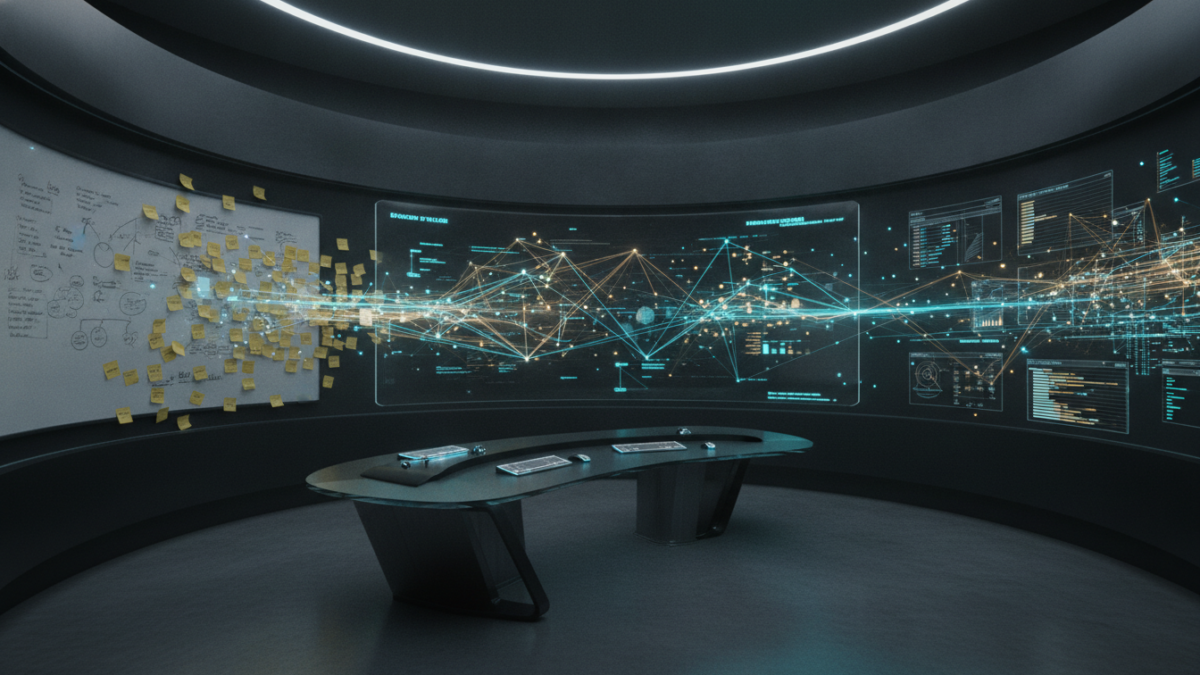
Every engineering lead, agency director, and project sponsor knows the quiet, grinding dread of the Friday status update.
You open Jira, Asana, Monday, or ClickUp, and immediately confront reality: half the cards haven’t moved in three weeks, three critical dependencies slipped without anyone noticing, a client sneaked in two massive scope alterations over an informal email, and nobody has the faintest idea whether the project is actually making money or bleeding margin.
The industry spent twenty years building increasingly colourful digital whiteboards, followed by three years pasting generative AI chatbots into browser sidebars to write “clever status summaries.”
The dirty secret of modern project delivery remains completely untouched: traditional project tools don’t run projects. Humans spend half their working week feeding the software, while the actual project runs wild in the real world.
And the current wave of “AI project assistants” is just as useless. They are cuffed. They sit in a chat bubble on the right side of your screen, waiting for a prompt, drafting polite summaries of stale tickets, and drawing burndown charts that describe failure long after the fact. They cannot touch your money, cannot inspect a supplier invoice, cannot verify a server deployment, cannot enforce a contract, and have zero authority to act on anything that matters.
At Wolfatek, we didn’t build another board with an AI sticker on it. We reinvented project management from the inside out. We took the handcuffs off and built an autonomous colleague who holds the actual reins of project delivery—unifying conversational execution, client transparency, contract governance, procurement, and the financial ledger into a single, living operating system.
Here is what happens when project management is rebuilt around an autonomous operator.
1. The Self-Driving Board: Zero Data Entry
The fatal flaw of modern project management is the context-switching penalty. An engineer finishes debugging an authentication pipeline on a live server, or an operations lead agrees to an immovable deadline shift during a call with a university registrar. In conventional operations, that person is expected to pause their work, open a browser tab, find the right project board, locate the ticket, and type out an update.
They almost never do. The information stays trapped in their head, an email thread, or a chat window. The board goes stale, and within weeks, it becomes a monument to fiction.
With Crystal, nobody does data entry. You talk, decide, and work—and the board keeps itself current in real time. Because Crystal operates across WhatsApp, enterprise voice, email, and live meetings with direct system access, project execution happens natively inside the conversation:
- Email-to-Project Semantic Fusion: Inbound correspondence doesn’t sit isolated in someone’s inbox. Crystal evaluates the message semantically, links the thread directly to the project feed, extracts key date commitments, and logs the strategic context into the project’s permanent timeline.
- Conversational Task Progression: When an engineer confirms on WhatsApp: “We just finished loading the voter roll and verified 14,000 student records,” Crystal marks the milestone task complete, ticks the corresponding audit checklist item, and recalculates the critical path toward go-live.
- Automated Release Markers: Deployments report themselves. When CI/CD or staging hooks fire, Crystal logs the release marker, transitions the delivered deliverables into “Ready to Try” on the client log, and notifies the team.
- Snags vs. Backlog Discipline: When a live operational defect or server glitch surfaces, Crystal logs it as a first-class snag with attached logs and screenshots, cross-references open defects to prevent duplicates, and routes it straight into triage without cluttering committed delivery milestones.
The PM’s job stops being data entry and becomes high-level executive review. The work and the record of the work become the exact same event.
2. Live P&L per Project: Profit as a Vital Sign
In traditional setups, project management software is completely blind to money. Jira doesn’t know what you paid a subcontractor; Asana doesn’t know if the client paid their 60% deposit; Monday doesn’t know your true labour margins. Project tracking lives in one silo, and accounting lives in another.
Because Crystal is an autonomous operations platform with a native double-entry general ledger, delivery and money are fused on one unified database:
- The Full Spend Picture: Crystal tracks all spend the project manager oversees, whoever pays it. Every cost line explicitly records who paid (us, the client direct, or a third party) and whether it touches our books. The PM sees total project expenditure; the business ledger tracks true company margin.
- Budget vs. Committed vs. Actual vs. Billed: When a purchase order is raised, cost is committed immediately. When the supplier invoice lands in the mailbox, it matches the PO, converts to actual spend, and updates the project’s live margin the same afternoon—never counted twice.
- Early Warning Before Close: Crystal warns you of a margin collapse while the project is running, not months later at reconciliation: “PRJ-0016 will land at 12% margin rather than the 35% quoted—the entire overrun is concentrated in the payment gateway integration, burning 55 hours against a 20-hour budget.”
- Dual-Control Progress Claims & Retention: Milestone billings and progress claims strictly respect contract retention rules. Crystal calculates earned value, drafts the certified claim and AR invoice, and leaves the final approval in human hands.
3. Truthful Forecasting & Project Vital Signs
A Gantt chart where someone manually drags coloured bars across a calendar is not a forecast—it is wishful thinking. When dependencies slip, manual schedules are rarely updated, leading to surprise blowouts on eve-of-launch deadlines.
Crystal structures projects as living journeys with real mathematical dependencies, immutable schedule baselines, and ambient vital signs:
- The Uncompromising Finish Line: Every project journey is anchored to an unambiguous, single-sentence finish line (e.g. “The first live locum shift booked, worked, and paid end-to-end through the platform”). Tasks that do not directly feed that finish line are immediately flagged as off-map scope creep.
- Mathematical Critical Path Recalculation: Tasks are linked by formal dependencies. When an upstream dependency stalls, Crystal instantly recalculates the entire critical path, showing exactly how many days the target milestone slips and which specific blocker is responsible.
- The Vital Signs Dashboard: Crystal monitors health through four objective metrics, not subjective smiley faces:
- Schedule Confidence %: Derived from actual team velocity, open dependencies, and historical completion rates.
- Margin Trajectory: Whether live profit is trending above or below baseline.
- Scope-Creep Index: The exact ratio of work added after baseline sign-off.
- Decision Latency: How many days critical decisions have been sitting unanswered.
- Ask the Project Anything: Because the graph is living, you can ask Crystal plain questions: “Why is the client launch delayed by four days?” She traces the critical path back through the stalled database migration, identifies the waiting API credential, and pulls the exact email where the request was sent.
4. The Client Portal: Turning Stalling Observers into Active Partners
Keeping clients informed has historically been an exhausting tug-of-war. Agencies either send sanitised, out-of-date PDF decks once a month, or make the mistake of inviting clients directly into chaotic internal boards where developer panic is laid bare.
Worse still is the decision deadlock: a project sits frozen for three weeks because the agency is waiting on client copy, asset sign-off, or an API credential buried in an unanswered email thread.
Crystal reinvents client collaboration through a dedicated Client Portal and conversational channels:
- Curated Transparency, Zero Leaks: By architectural default, internal tasks, technical developer snags, and commercial margins are strictly hidden. Clients see high-level milestone progress, clean visual journeys, and a human-readable “What’s New” log written in plain business language with proof and try-it links.
- The “Needs You” Decision Queue: When work stalls because a choice belongs in the client’s court, it surfaces in a dedicated portal queue. Trade-offs and our recommendations are laid out plainly, showing exactly which deliverables are waiting. Clients can record binding decisions with a single tap.
- Decisions via WhatsApp & Email: Clients don’t even have to log in. Crystal can send a single, batched WhatsApp summary when open decisions are pending. The client can simply reply “Option B”, confirm with a quick “YES”, and Crystal automatically logs the audit evidence and unlocks the dependent tasks on the board.
- Audit-Locked Timelines: Every decision is timestamped and attributed. The endless finger-pointing of “Why was the project late?” disappears, because both parties have an indisputable, shared record of exactly who held the ball at every stage.
5. The Scope Register & The Work Gate: Stopping Goodwill Bleed
Nothing destroys agency profitability faster than informal scope creep. A client asks for a “small tweak” over lunch; an eager engineer implements it without checking the spec; two weeks later, 80 unbilled hours have evaporated from the project margin.
Crystal enforces an architectural firewall between the Scope Register and the delivery backlog:
- Verbatim Ingestion: Whenever a client asks for something new via email, chat, or a meeting, Crystal captures the request verbatim in their own words.
- Contractual Evaluation: She compares the request against the baseline specification and suggests an objective classification: in_scope, out_of_scope, or unclear.
- The Work Gate: Any task linked to an unapproved, out-of-scope request is locked behind an automated Work Gate (“Awaiting change approval”). Developers cannot start work, and hours cannot be burned until a project lead formally reviews the variation—choosing to quote a change order, grant it as goodwill, or decline it.
- Goodwill Visibility: When you choose to absorb an extra feature for free, Crystal can display it on the client portal as a Goodwill Contribution with its real market value attached. The client sees the value you gave them, turning an unacknowledged concession into client loyalty.
6. Autonomous Procurement & The Supplier Firewall
For projects requiring external subcontractors, hardware, or third-party materials, procurement is usually a mess of scattered quotes, delayed deliveries, and leaking margins.
Crystal handles the procurement cycle autonomously while keeping humans in firm control of the money:
- Bill of Quantities (BOQ) Ingestion: Crystal reads materials lists and budgets directly from spreadsheets, creating structured requirements with required-on-site dates.
- Scoped RFQ Preparation: Crystal drafts standardized quote requests for approved suppliers. She compares returned quotes like-for-like, flagging price variances, substitute parts, and lead-time risks.
- The Supplier Firewall: Crystal strictly isolates commercial sides. Subcontractors and suppliers never see your client sell prices, your internal margins, or third-party workings.
- Human-Only Award: Crystal analyses and recommends, but only a human project manager can award the quote and approve the drafted purchase order.
7. Projects That Learn: Institutional Memory That Compounds
In most companies, every project starts from zero. The hard-won lessons of last year’s rollout—which testing phases blew out, which suppliers delivered late, which approvals took three weeks—retire when the project ends or walk out the door when an employee leaves.
Because Crystal maintains a continuous memory loop across all company operations, projects get smarter over time:
- Estimate Calibration: Crystal analyses historical estimates against actual logged hours. If your team consistently underestimates third-party API integration by 1.5×, she flags the bias during initial milestone planning.
- Evolutionary Project Templates: Closure feeds the next kickoff. Last year’s actual cycle times become this year’s realistic schedule baselines; last year’s unforeseen snags become this year’s automated pre-flight checklists.
- Autonomous Post-Mortems: When a project finishes, Crystal runs a structured retrospective unprompted—identifying where margin was made, where decisions stalled, and which subcontractors performed reliably.
Stop Feeding Software. Put It to Work.
For two decades, business software has operated as a hungry mouth that teams must constantly feed with manual updates, ticket adjustments, and reconciliations.
Crystal ends the administrative tax on delivery.
By bringing conversational execution, living journey maps, live general ledger profit tracking, contract-grade scope gates, and transparent client collaboration under one autonomous operator, we didn’t just build another project management tool.
We reinvented project management. The reins are held, the gates are locked, the numbers are honest—and your team is finally free to build.